Despite Roadblocks, Journalism Is Doing Its First Amendment Job
Over the last 20 years, 3,500 U.S. newspapers have abandoned print publication. Two thirds of U.S. journalists have lost their jobs. Congress has stopped funding public media. The Corporation for Public Broadcasting has shut its doors.
Google, Facebook and other Internet sites have diverted billions of what once were newspaper advertising revenues into their own coffers. As a consequence, Atlanta, Seattle, Denver and other cities, large and small have lost advertising supported printed newspapers that once provided town squares for their communities.
The information space, on which a healthy democracy depends, has been hugely transformed due to technological change.
With Donald Trump as president, the downhill slide of legacy media has been compounded. The White House has used its many levers of power to bend public information for its own purposes, including legal action against reporters and outlets that write and publish news the White House would rather not see in the media. An aggressive right wing cadre of commentators openly advances Trump’s agenda.
All true. But…
Even though many once important news outlets are disappearing or are being neutered, and Trump’s White House is doing more than any administration in history to skew the news, where then are Americans getting the information that has turned their view of Trump historically negative?
A thorough answer to that question requires far more study than I have space, time and brain power for. But the short answer is that journalism’s not what it used to be. And that may turn out to be a good thing. The legacy media crisis may be what 21st century democracy needs—an alternative to news gatekeepers that according to Gallup only 28% of Americans now trust.
The Decline of Traditional News Gatekeepers
A personal reflection. Years ago, I was editor of the Anchorage, Alaska Daily News, a morning newspaper. Not infrequently I would drive home in the early morning hours, ego inflated with the knowledge that the city would wake up to whatever I considered that day’s news. I had assigned reporters to cover some stories, not others. I had overseen the editing and the headlines and the page placement of local and national stories and editorials. Once on the street, local radio stations would read and rewrite our stories for their own newscasts.
What power! I was too young and inexperienced to realize I had no business exercising it.
Larger papers with larger and more experienced staffs operate similarly, as news gatekeepers. Most of them are true to journalism’s standards for accuracy and fairness. They are also expensive businesses, supported in large part by local advertisers, necessarily conscious of the business community and the wealthy owners who pay the bills and write the checks.
Case in point. The current version of the Washington Post, owned by mega billionaire Jeff Bezos, is a far different publication with much different executives and editors than what it once was in Watergate days.
All over the U.S., private equity is buying distressed papers, pocketing whatever revenue there is, running up debt, cutting staff and using bankruptcy as a business model. Vulture capital is feeding off what once was a vital community asset.
The Rise of Alternative Digital News Outlets
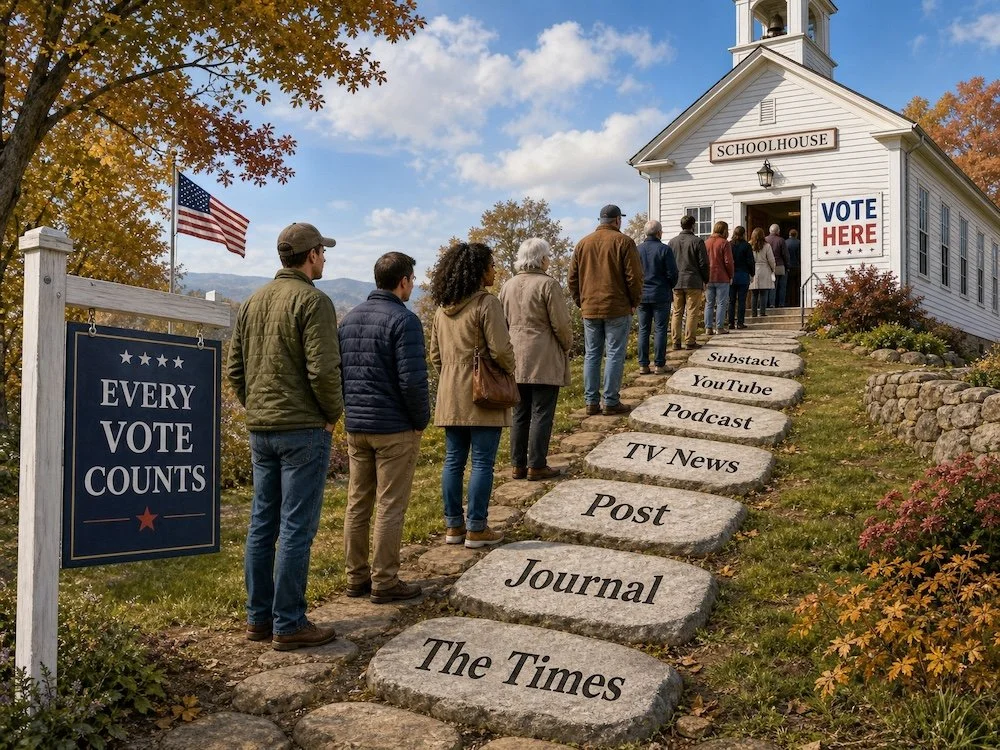
But now, the gatekeepers have serious competition.
YouTube is America’s primary news channel, with TV streaming available to 200 million people. An estimated 35% of adults regularly turn to YouTube for news and information.
Podcasts: Tens of millions tune in to them weekly, accessing thousands of viewing and listening choices on phones, ipads and computers.
Substack: An Internet service open to anyone who wants to write about anything has thousands of writers and 50 million subscribers. Case study: Nobel prize winning economist Paul Krugman for years wrote a weekly, 800-word column published in the New York Times. Now he publishes daily on Substack with no editors to question or reject his copy, and no word limit. He has about 600,000 subscribers, more than the daily print circulation of the New York Times itself. Heather Cox Richardson, a historian who might otherwise have found no forum beyond her profession, has nearly 3 million subscribers.
Email: My views that you are reading, if you’ve read this far. In the “old” days I would have had to convince a gatekeeper somewhere to publish them. For better or worse, I decide.
Not only are these and other formats gaining popularity as news and information sources, legacy media itself is entering uncharted waters.
The New York Times has an audited print circulation of about 550,000. But it has nearly 13 million subscribers for its digital service, which now competes with video outlets.
One of the fastest growing newspapers read by U.S. subscribers is the Guardian, a British publication that few Americans had ever heard of before we entered the digital world.
The PBS News Hour reaches an average 2 million viewers with its nightly TV broadcast. But it gets 100 million monthly views on YouTube and other streaming services. The same multiples work for ABC, NBC, CBS and Fox.
How Informed Voters Are Navigating Modern Media
The public’s appetite for news and information is no different now than in the salad days of print and TV broadcast monopoly.
There are, of course, serious downsides. Hundreds of small communities have lost their only newspapers with no satisfactory replacement. Giving everyone a megaphone has resulted in a flood of lies, conspiracies and socially disruptive communication. And so on. The transformation is still very much a work in progress. But on a national level we are learning how difficult a chore it is for a U.S. government to suppress information that it doesn’t want published.
For 250 years Americans have been imbued with the truth that democracy can’t work without an informed public.
Judging by recent political surveys and primary election results, despite White House road blocks and technological hurdles, voters will go to the polls in November with informed opinions, and plenty of them.
Comments? Criticism? Contact Joe Rothstein at jrothstein@rothstein.net
Always Get It’s Always Something
Sign up to get the most recent column set to your inbox for free.


What happens when a fun-loving, charismatic, reform-minded Mexican-American billionairess becomes president of the United States and strikes fear in the pocketbooks of a cabal of the rich and powerful?