Should ‘Shareholder Value’ Be A Company’s Only Priority?
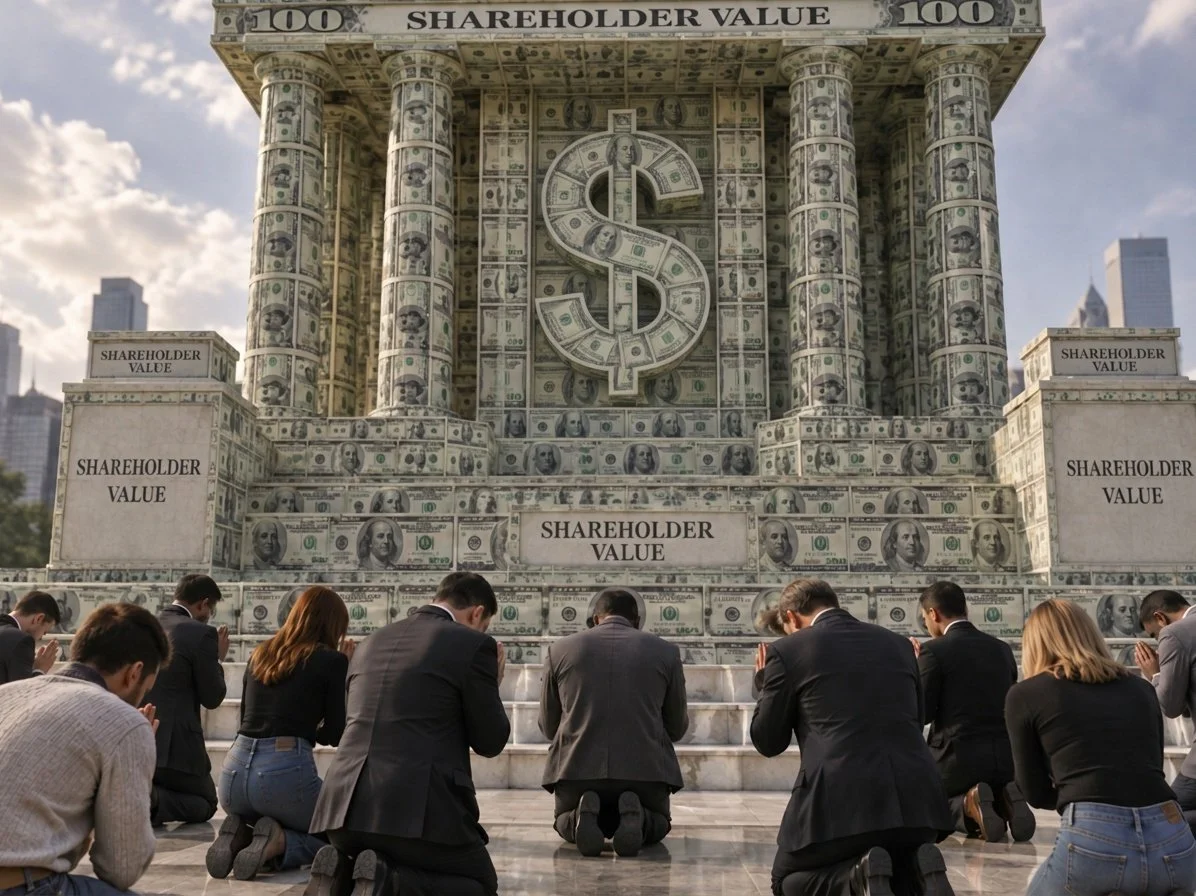
Shareholder value. Om….
Shareholder value. Om….
Shareholder value is the mantra of most U.S. business.
The goal, and only goal of most who manage U.S. companies is to maximize profits for their shareholders.
That idea is so embedded in our culture and our legal system that companies may be successfully sued for compromising profit for any other goal. Who are these shareholders requiring such fierce loyalty and protection?
According to the Federal Reserve, the richest 10% in the country now own up to 93% of all household held stock market wealth. The bottom 50% own 1%. Shareholder value, in other words, is a euphemism for helping the extremely wealthy to keep adding to their fortunes.
How ‘Profit Only’ Became the Corporate Legal Mantra
It hasn’t always been this way. Not that long ago, General Electric’s corporate philosophy was as a “trustee for the balanced best interest of stockholders, employees, customers, suppliers and plant communities.”
At the time GE was not what many today would consider an outlier “woke” company. Hardly. It was one of the five largest corporations in the U.S., employing more than 200,000 workers. Standard Oil of New Jersey (EXXON), Johnson & Johnson, Sears Roebuck and other corporate giants had similar standards.
Back then, when a New Jersey manufacturing firm made a corporate donation to Princeton University, some shareholders sued, arguing that spending corporate funds on non-business social causes violated management's fiduciary duty. The New Jersey Supreme Court ruled against the shareholders, establishing what was then a milestone precedent that modern corporations have an explicit right—and social duty—to support public and community welfare.
That was then.
That was before economist Milton Friedman published a seminal 1970 essay in The New York Times Magazine, arguing that the sole social responsibility of a business is to increase its profits for its shareholders.
And it was before the Michigan Supreme Court ruled in Dodge v. Ford Motor Co. "A business corporation is organized and carried on primarily for the profit of the stockholders.”
And it was before the Delaware Chancery Court prohibited corporate boards from considering the impact on consumers, communities and employees when deciding to sell or merge a company. Delaware is the legal home to more than half of all publicly traded U.S. corporations. Its rulings effectively set national corporate law.
The Cost of Prioritizing Shareholder Value Above All
Since then, corporate managers have adopted the “profits only” goal with a vengeance.
Entire communities have been economically destroyed as corporate leaders, focused only on profits, have abandoned longstanding U.S. factories for low wage sites elsewhere. When RCA / Thomson Consumer Electronics, for instance, moved thousands of electronics manufacturing jobs from Bloomington, Indiana to Guandong China, that led a competitor exodus that virtually extinguished the U.S.-made TV electronics industry.
Such stories are legion. The “rust belt” of abandoned towns and workers has changed not only the economies, but the politics of entire U.S. states and regions.
GE, which once took pride in corporate responsibility, abandoned that goal to became a profit machine, laying off tens of thousands of U.S. workers. All to the detriment of the company’s long term viability. To survive after the financial crisis of 20008, GE was forced to sell off whole divisions.
Boeing, once one of the world’s most admired companies as an engineering-first firm, joined the profit race after its 1997 merger with McDonnell Douglas. To maximize shareholder value it cut operational costs, paid out $43 billion in stock buybacks, and priority focused on ways to raise its stock price and pay dividends. Then, when Airbus launched a more fuel efficient airplane, Boeing cut corners to catch up. Its 737 Max was involved in two fatal accidents involving the deaths of 346 people. Its customer base collapsed. It plead guilty to charges of defrauding the U.S. government. Boeing has become a cautionary tale taught to business school students.
On the other hand, Walmart prospered. By blackmailing suppliers to produce cheaper goods elsewhere than their established manufacturing roots. Or else.
That brings us to artificial intelligence, not a pure case of shareholder value, but close enough given the greed so many billionaire bros have demonstrated lately. The competition for who will “own” artificial intelligence could well be a threat to the very existence of humanity.
Shareholder value.
Benefit Corporations and the Future of Shareholder Value
For decades, we’ve lived with “shareholder value” as if it’s etched in stone. It’s not. Public policy decisions got us here. Public policy decisions can change. It’s already happening.
One way is by legally rewriting the corporation’s charter to become a Benefit Corporation. With this designation, companies explicitly modify their fiduciary duties. Instead of being legally bound to optimize purely for short-term stock value, directors are legally required to balance shareholder financial interests alongside public benefits—such as environmental sustainability, worker welfare, or community health. The only states that do not recognize Benefit Corporations are Alaska, Michigan, Mississippi, Missouri, North Carolina and North and South Dakota.
Here’s where you can read more about this and see which corporations have chosen to become Benefit Corporations.
For corporations not wanting or able to change legal status, there’s the option of qualifying for ESG investing. That is, managing their environmental, social and governmental decisions as if they were Bcorps. Third-party rating agencies MSCI, Sustainalytics , S&P Global and others assess corporate disclosures and sustainability performance and publish reviews of qualifying companies. Investors can target their choices to those companies and ESG funds. Depending on which qualifying agency you use, 13,000 to 17,000 companies currently qualify for ESG designation.
So far this year, despite the war on “wokeness,” according to MSCI, global sustainable funds have delivered a median return of 4.9% compared with 4.0% for traditional funds.
For more than 40 years, “shareholder value,” has been the mantra for most U.S. business. It’s time to reconsider the beforetimes, when business defined itself, and its long term best interest, as a valued part of a wider community.
Add that to the long list of public policy changes worth pursuing in this election year of change.
Comments? Criticism? Contact Joe Rothstein at jrothstein@rothstein.net
Always Get It’s Always Something
Sign up to get the most recent column set to your inbox for free.



What happens when a fun-loving, charismatic, reform-minded Mexican-American billionairess becomes president of the United States and strikes fear in the pocketbooks of a cabal of the rich and powerful?