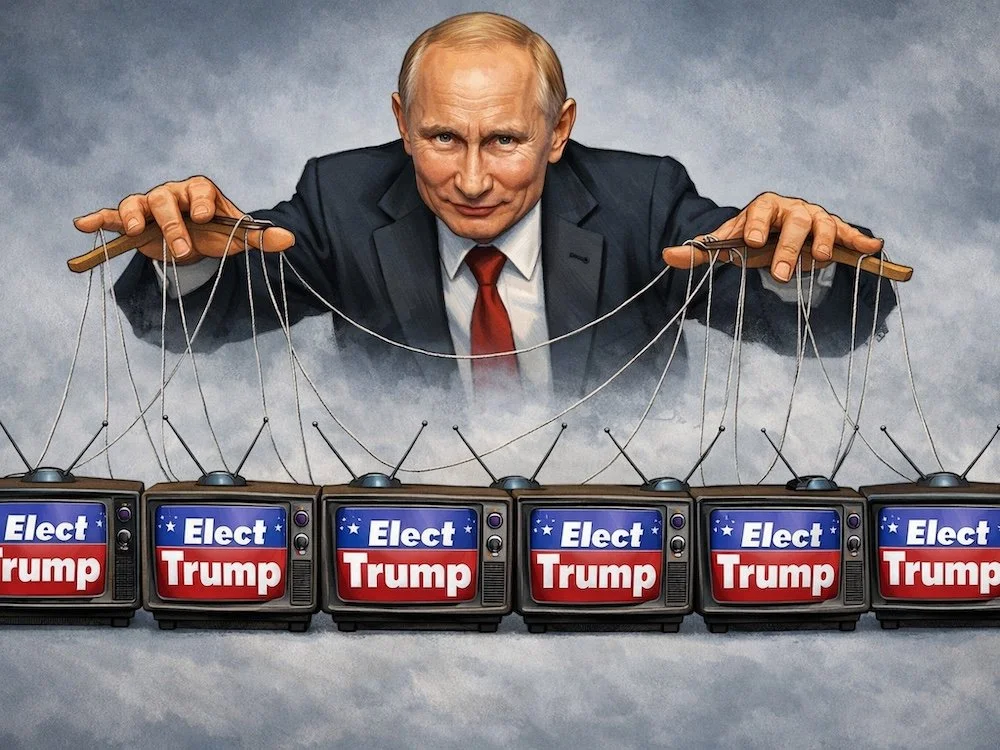
Donald Trump insists we focus on the danger of foreign interference in past U.S. elections. I agree. But let’s not forget the election of 2016, and how Russia helped Trump get elected. Here’s a condensed version of an op-ed I published on the web site US Politics Today November 6, 2017, to help us remember.
The front lines of campaign strategy and communications are complex, research-based, and dynamic, changing as the technology and learned new techniques change. Political professionals at the top of their game struggle to keep up with the design and execution of today’s political campaigns.
So we’re expected to believe that the Russians, working thousands of miles away, with little experience with our campaign process, figured it out, on their own, well enough to influence the result of the 2016 election? No way.
In addition to the complexity of the communication puzzle, overlay the uniquely diverse U.S. culture. Multiple ethnic and religious backgrounds, educational and income variables, geographic dissimilarities.
How Did the Russians Get Local U.S. Politics So Right?
I live in Washington, D.C. where the Washington Post and local TV are focused, not just on D.C. news, but on adjacent Maryland and Virginia as well. Because I follow local news, I’m aware of local debates on where power lines go, whether a new lane is added to an already busy highway, water treatment problems, cultural wars over what might be taught about evolution or sex. Lots of issues common to our extended community.
Wherever we live in the U.S. there are local factors that influence our outlook. Yes, your vote might be determined by your party affiliation or “top line” issues, such as where you might come out on continuing to send troops to Afghanistan. But in elections for president, fully 20 to 30 percent of the total vote can be determined by attitudes developed around local issues, peer group factors and personal contacts. That was particularly the case in 2016, when the voting public was not excited about either major party choice for president.
As I scrolled through the ads Facebook and Twitter officials showed Congress, those paid for by Russian front groups, I saw ads exquisitely designed to appeal to local issue preferences and personal anxieties. After all, that’s why so much advertising now goes into these platforms, precisely so that savvy advertisers can directly reach their targeted audience. Pretty smart of those Russians to have figured this all out, including all the individual voter metrics. Too smart to be believable.
Finally, there’s the matter of language. Think of your friends and acquaintances for whom English is a second language, even those who speak it very well. It’s not the same as you or me or anyone for whom American English is native, is it? Articles and prepositions sometimes are missing. Uncommon words may be a struggle for them to recall or pronounce. Colloquial expression is often a challenge.
Now, look at all of these ads and see if you can find any mistakes in spelling, grammar, proper punctuation, abbreviation, or any language errors at all. And don’t overlook the fact that many are tied to art and photos that required extensive research to perfectly fit the message.
Flawless English and 2016 Election Foreign Interference
Oh, one more thing. We trace the origin of the English language back to the Latin of Rome. Russian is based on Cyrillic, with origins in Greek. The saying, “It’s all Greek to me,” underscores the difficulty for those of us in the English-speaking world to bridge the gap. Learning Russian begins with learning an entirely new alphabet. Many word meanings are foreign to our own, even in translation. It works the other way, too, for Russians learning English.
I’m sure there are plenty of Russians capable of perfectly handling both languages. But the Russian advertising campaign was so extensive it required a literary army. Remember, in addition to countless perfect linguists, to pull this off the Russians also would have required a parallel army of those expert in nuanced cultural differences. A third group would have needed to rival American research and media professionals in their understanding of political campaign communications.
Going back to where I began this column, with disbelief that the Russian advertising campaign was solely a Russian advertising campaign, I can think of only two other explanations for its brilliance and its success.
One, that independent of both presidential campaigns, the Russians hired American experts needed to help pull this off. If that were the case, why haven’t any of those who participated come forward to say so?
The other possibility is that the Russians had access to Trump’s database, the campaign’s targeting information and advertising expertise and likely a lot of the writing talent available to the Trump campaign.
Could Russia Really Have Done This Alone?
I wrote that newsletter at a time when Independent Counsel Robert Mueller was deep into his investigation of Russia’s interference in the 2016 election. Here was his conclusion: “The Russian government interfered in the 2016 presidential election in sweeping and systemic fashion.”
His investigation produced 37 indictments; seven guilty pleas or convictions; and compelling evidence that to hide his campaign’s role in Russian interference, Trump obstructed justice on multiple occasions.
Most people would consider all of that collusion. Mueller didn’t. Which, to this day, is baffling, and allowed Trump to avoid the consequences, even though he did everything he could to impede Mueller’s investigation.
A statement signed by over 1,000 former federal prosecutors concluded that if any other American engaged in the same efforts to impede federal proceedings the way Trump did, they would likely be indicted for multiple charges of obstruction of justice.
In calling out China for election interference, Trump offered no evidence. In calling out Russia for helping Trump win in 2016, the evidence is overwhelming. To believe the Russians did this all on their own is fantasy.
So, yes, let’s reopen the question of foreign interference. And this time let’s place accountability where it belongs.
Comments? Criticism? Contact Joe Rothstein at jrothstein@rothstein.net
Always Get It’s Always Something
Sign up to get the most recent column set to your inbox for free.


What happens when a fun-loving, charismatic, reform-minded Mexican-American billionairess becomes president of the United States and strikes fear in the pocketbooks of a cabal of the rich and powerful?