Down Ballot Races Count More Than Ever This Year
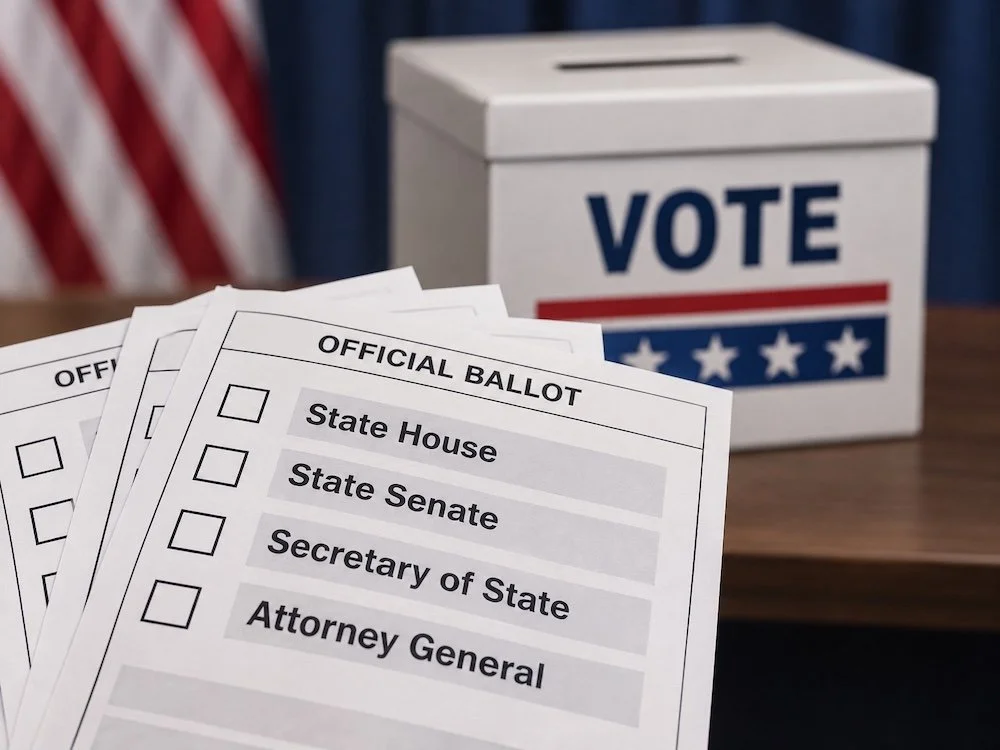
In 2010’s non-presidential year election, Republicans won control of state legislatures in Indiana, Iowa, Michigan, Minnesota, New Hampshire, Ohio and Wisconsin. In 25 states they gained control of both houses. With that control, after the 2010 census, they reapportioned state and federal voting districts with hyper partisan abandon to lock in their majorities.
The result has been state election maps so tilted to Republicans that it’s been nearly impossible for Democrats to win legislative races at both the state and federal levels. Pennsylvania has been dividing its statewide votes about 50:50 in recent elections. But as a result of hyper partisan gerrymandering, Republicans hold 13 of 18 of the state’s congressional seats. North Carolina also is a swing state, but not for Congress, where 11 of its 14 U.S. House members are Republicans.
It takes a blue wave election for Democrats to overcome the damage done to their prospects in 2010.
2026 Democratic State Legislative Seats and Targets
Such a blue wave seems to be building ahead of November’s election, and Democrats are keen to make the most of it. They’ve targeted 398 Republican held state legislative seats to flip, one-third of them in districts Trump lost in 2024. Many of those targets require minimal victories to make a major difference in state house and senate majorities: Three in Arizona’s state senate and 4 in its house; 4 in Michigan’s house; 1 in Minnesota’s house; 2 in Wisconsin’s senate and 5 in its state assembly.
Overall, the Democrats are hoping to win control or end Republican super majorities in Florida, Iowa, Indiana, Kansas, Montana, North Carolina, Ohio and South Carolina.
What gives the Democrats optimism that this is achievable? Since Donald Trump took office in January 2025, Democratic candidates have flipped 31 state legislative seats, some in deep red Texas, Arkansas and Mississippi. For the first election cycle since 2010, Republicans haven’t flipped any.
Federal Impact: Redistricting and Electoral College Balance
The battle in the down ballot trenches isn’t getting much national notice, but it has enormous implications for the future of U.S. politics and government. Here’s what’s at stake:
Redistricting.
With majorities in state legislatures Democrats would have power to untie the stranglehold the GOP has created in states where Democrats have little representation in Congress. With Trump’s off year redistricting as precedent, Democrats likely would not wait until the 2030 census to act.
Electoral College.
In the event the 2028 presidential election ends in a tie, the decision goes to the U.S. House, which votes by state. No matter the popular vote winner, if the other party has the majority in each state delegation, it has the power to ratify its own candidate. Currently, Republicans have majorities in 30 states, Democrats 18. Two states have split delegations. Improving Democratic chances to win congressional seats would alter that balance.
Setting Election Rules and Down-Ballot Races
Setting election rules.
State legislatures set the voting rules. Voter ID laws, registration dates, mail in ballot rules, signature matching, ballot harvesting, postmark deadlines and other details that influence ease or difficulty of voting. All of this has been under attack where Republicans now have legislative majorities.
Given the role attorney generals have had in efforts to blunt or defend Trump excesses, other down ballot races also are highly important. Thirty states are electing AGs in November. With Trump’s assault on voting rights, secretaries of state have new significance. Twenty-six of those offices are on state ballots this year, 13 of them are open seats.
With the avalanche of top of the ticket campaign spending this year it’s easy to lose sight of low visibility races. But with voting itself under siege, state down ballot elections will have a huge role in what happens next.
Comments? Criticism? Contact Joe Rothstein at jrothstein@rothstein.net
Always Get It’s Always Something
Sign up to get the most recent column set to your inbox for free.



What happens when a fun-loving, charismatic, reform-minded Mexican-American billionairess becomes president of the United States and strikes fear in the pocketbooks of a cabal of the rich and powerful?